Overview
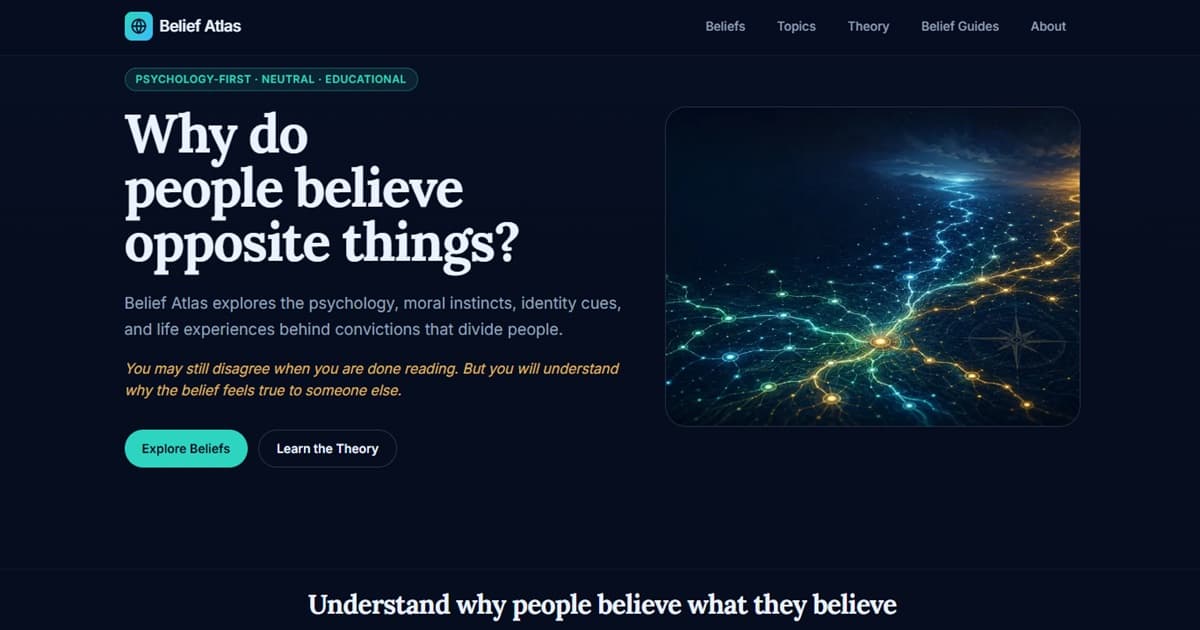
Belief Atlas is an educational project focused on helping readers understand why people hold opposing beliefs across culture, politics, economics, religion, morality, and science. Rather than debating correctness, the site examines the psychological, social, and experiential foundations that make certain convictions feel true to sincere individuals. Each belief is presented in a steelmanned form, paired with its opposite, and supported by a structured "Belief X-Ray" that breaks down its moral center, underlying fears and hopes, what critics hear, and a bridge question for better conversations.
What you can explore
The site offers a wide range of belief explanations organized by topic areas such as Culture, Economics, Morality & Law, Politics, Religion & Origins, and Science & Trust. Readers can explore featured beliefs, recently published articles, and a comprehensive archive. Each belief entry includes an in-depth psychological and sociological explanation, along with the Belief X-Ray framework.
Belief Atlas also provides a Theory Library containing evergreen explainers on concepts like Moral Foundations Theory, Motivated Reasoning, Confirmation Bias, Cognitive Dissonance, Identity-Protective Cognition, and Sacred Values. These resources help readers understand the cognitive and emotional mechanisms that shape belief formation and disagreement.
Who it is for
Belief Atlas is designed for readers who want to understand the deeper reasons behind public disagreement. It is useful for anyone interested in psychology, sociology, political behavior, moral philosophy, or conflict resolution. The site is also valuable for educators, students, journalists, and individuals seeking to engage in more empathetic and informed conversations.
AI personas and guides
The site features named Belief Guides who author the articles:
- Dr. Mara Ellison – Cognitive psychologist focused on belief formation and identity pressures.
- Professor Theo Calder – Moral philosopher examining the moral architecture behind disagreement.
- Dr. Lena Ortiz – Cultural sociologist studying how culture, institutions, and lived experience shape belief.
These guides are explicitly presented as the voices behind the site's explanations. No named AI persona was verified beyond the general disclosure that some articles may be generated by AI.