Overview
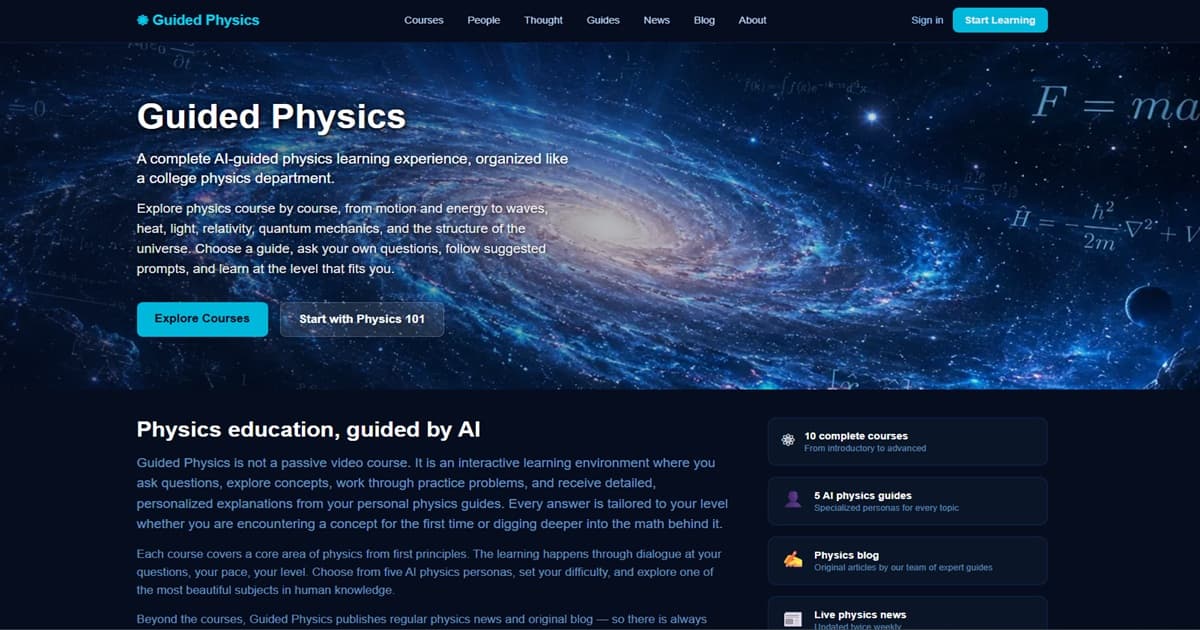
Guided Physics is a free, AI-powered educational website organized like a college physics department. It combines a structured curriculum with conversational learning: visitors can read lessons, choose an AI physics guide, select a difficulty level, and ask questions about the material. The site presents ten complete courses ranging from introductory physics and mathematical methods to quantum mechanics, special relativity, and astrophysics and cosmology.
The AI chat is available through a dedicated physics chat page and within course and lesson pages. Responses can include explanations, equations, examples, analogies, hints, worked problems, and suggested follow-up questions. The site states that its chat is powered through OpenAI and that AI answers are educational aids rather than replacements for qualified instruction.
What you can explore
The curriculum includes Introduction to Physics, Mathematical Methods for Physics, Classical Mechanics, Waves and Oscillations, Thermodynamics and Statistical Mechanics, Electricity and Magnetism, Optics and Light, Special Relativity, Quantum Mechanics, and Astrophysics and Cosmology. Courses are divided into modules and individual lessons, and learners can follow recommended paths or move directly to topics of interest.
Guided Physics also includes profiles of notable physicists, an educational blog, curated physics news, resource pages, and a collection of major thought experiments such as Galileo’s falling bodies, Newton’s cannonball, Maxwell’s demon, Einstein’s train and lightning, and Schrödinger’s cat. Users who sign in with Google can track completed lessons, resume from their last lesson, and earn printable course-completion certificates.
Who it is for
The site explicitly identifies high school students, college students, homeschool families, curious adults, teachers, and self-directed learners as intended audiences. Adjustable levels range from beginner explanations without equations to mathematically advanced treatments, allowing visitors to approach the same subject with different levels of rigor.
AI personas and guides
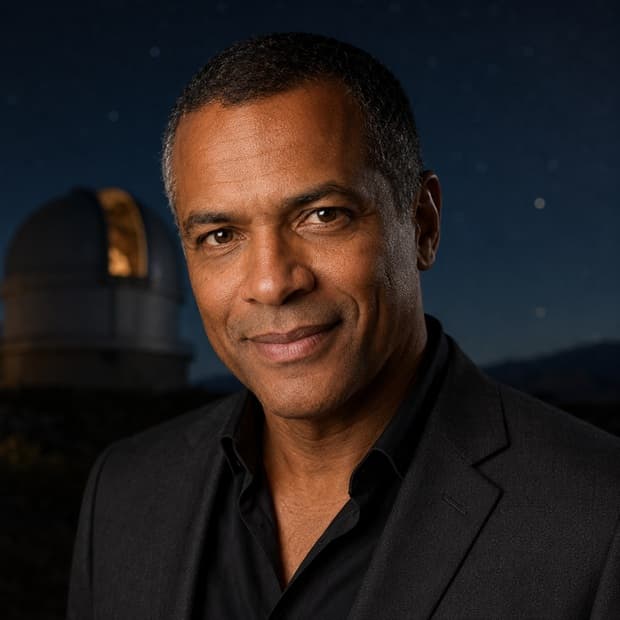
Guided Physics features five named fictional AI teaching personas: Dr. Isaac Rowan for classical mechanics and mathematical physics; Dr. Maya Chen for electricity, magnetism, waves, and optics; Dr. Elena Voss for quantum mechanics and modern physics; Dr. Marcus Hale for relativity, gravity, astrophysics, and cosmology; and Prof. Ada Sinclair for laboratory physics, computational physics, and problem practice. Each has a distinct teaching approach, and the site clearly states that the persona biographies and professional histories are invented.