Overview
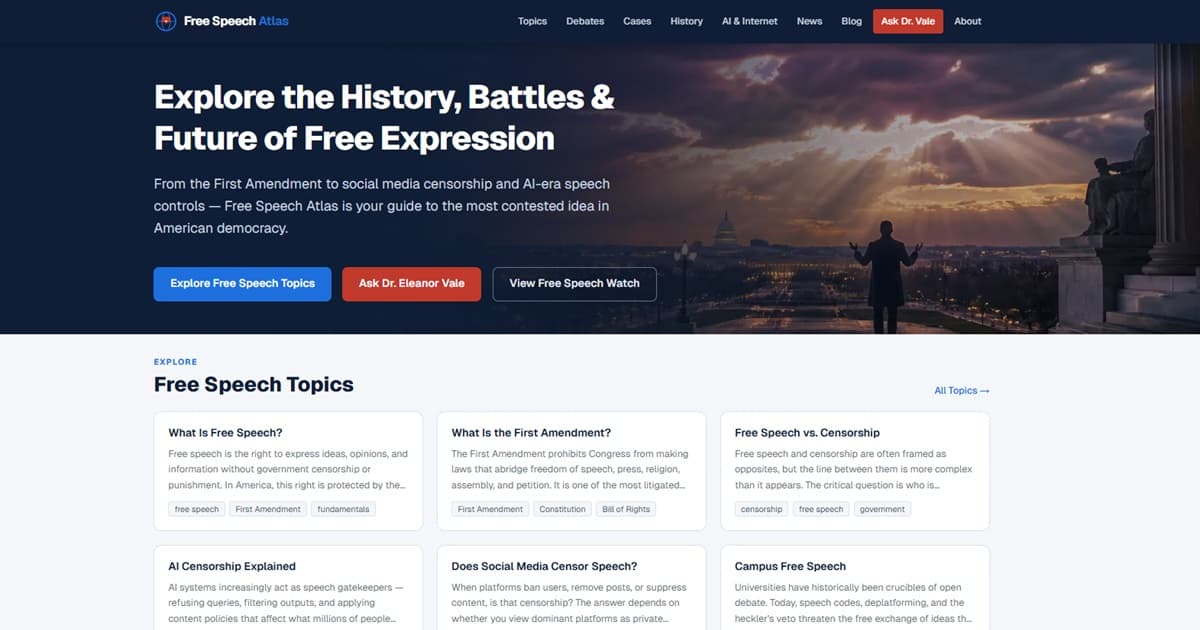
Free Speech Atlas is a nonpartisan reference and analysis website focused on free speech law, First Amendment doctrine, censorship, and the history and future of expression in the United States and around the world. The site explains legal principles while also examining cultural, technological, and policy disputes. Its stated approach is to present competing arguments fairly, distinguish settled doctrine from contested interpretation, and favor robust speech protection consistently across political viewpoints.
The project uses large language models to assist with drafting, research, and content structure, but says human editors review, edit, and verify material before publication. It provides educational and historical information rather than legal advice.
What you can explore
Visitors can browse in-depth topic guides covering First Amendment fundamentals, political and symbolic speech, prior restraint, incitement, defamation, true threats, campus speech, book bans, misinformation, content moderation, private-platform rules, and artificial intelligence. A debates section presents major controversies through strong arguments on multiple sides, including hate-speech restrictions, election deepfakes, online anonymity, platform liability, fact-checking, and government regulation of algorithms.
The case library explains landmark and recent free speech decisions, while the history section traces expression and censorship from the printing press and colonial America through wartime suppression, civil rights, campus conflicts, the internet, and the AI era. The AI and Internet section examines chatbot policies, automated moderation, synthetic media, political bots, voice cloning, AI search, defamation, and government influence over private platforms. The site also includes a glossary, current-news commentary, weekly analysis, an editorial policy, and a sources and methodology page.
Who it is for
The site is intended for readers who want to understand free speech law, history, policy, and the strongest arguments surrounding contested expression. Its explanatory format can support students, educators, general readers, and anyone following modern debates about courts, schools, media, technology platforms, censorship, or artificial intelligence. Because legal rules can change and summaries may be incomplete, the site advises independent verification for consequential purposes and consultation with a qualified attorney for legal questions.
AI personas and guides
Dr. Eleanor Vale is the site's resident AI guide and editorial voice. She is explicitly identified as a fictional persona, not a real scholar. Visitors can ask her about First Amendment principles, landmark cases, censorship history, campus and school controversies, social media moderation, political speech, misinformation, AI censorship, deepfakes, and online expression. Her responses provide educational and editorial guidance, not legal counsel.